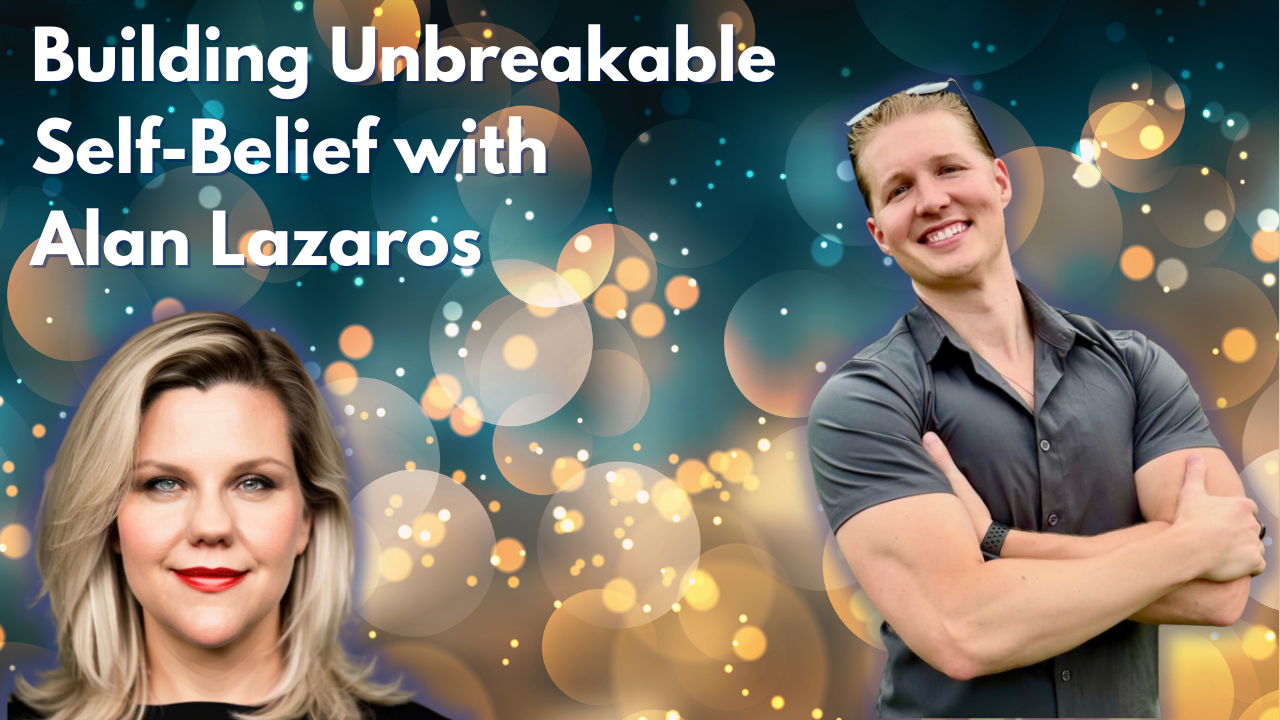
Alan Lazaros, founder and CEO of Next Level University, a top-ranked podcast and thriving coaching business with over 2,300 episodes and a global reach joins us to tell us his life story and how he’s found success.
Alan shares his raw journey through profound loss, and how these wake-up calls shifted him from autopilot achievement to intentional personal growth.
He reveals why only about 4% of people truly believe in themselves at a deep level—and how this “unbreakable self-belief” fundamentally changes motivation, goal-setting, and resilience to failure. For high self-believers like Alan, setbacks ignite drive; for most, they trigger doubt and the “Doom Loop.”
Drawing from his 11+ years of coaching, thousands of hours, and work with high-achievers, Alan breaks down practical strategies: aligning goals with your actual self-efficacy, building belief through the “state-prove-self-assign” formula, embracing personal responsibility, starting with health as the foundation, and escaping learned helplessness in a world full of excuses.
Whether you’re rebuilding confidence after setbacks, scaling a coaching practice, or chasing bigger dreams in 2026, this conversation delivers no-BS insights on turning adversity into unbreakable self-belief and sustainable success.
Timestamps
- 00:00 Intro
- 00:27 Meet Alan Lazaros
- 02:37 Early Loss and Family Upheaval
- 04:04 Boats and BS Childhood
- 06:44 Trauma Responses and Drive
- 07:20 Crushing School and Corporate
- 09:14 Car Crash Wake Up Call
- 10:30 Building Next Level University
- 12:00 Fitness First Foundation
- 14:52 Personal Responsibility and Accountability
- 20:46 Goal Setting and Self-Belief
- 25:02 Failure Fuels Winners
- 25:49 Confidence and Self Talk
- 28:02 Outputs vs Inputs
- 30:10 Reverse Engineer Success
- 33:18 State Prove Self Assign
- 33:53 Learning From Legends
- 37:45 Coaching Business Blueprint
- 40:00 Doom Loop vs Success
- 43:00 Fear of Shining
- 45:53 Success Gets Villainized
Links
Transcript
Welcome back to Zantastic. This is the podcast where we talk about what makes you fantastic. Now, you probably want some things in your life. You probably set some goals for yourself for 2026, it’s March. How’s it going? Are you working towards those goals? Have you achieved the things that you’ve set out for in the first quarter?
How’s it looking for all of those resolutions? Or did you give up on them already? My guest today has a very interesting take on why people don’t get the things that they’ve set out to do. He is a coach, Alan Lazaros. And he has had a very interesting life experience. He tells us about that in the first part of the episode, but later we start talking about the different mindsets that go into achieving greatness and achieving success.
Alan tells us that only 4% of people actually believe in themselves, and they’re motivated very differently than people like you and me, normal people who don’t believe in ourselves all that much. I’ve had to use NLP and all sorts of things in order to trick myself into self-belief. Taking a lot of action and then basically framing results in a way that spurs me towards greater growth.
I’ve had to play all sorts of tricks. But Alan is different. Alan believes in himself no matter what, so he has. Different ways of motivating himself. Failure is actually motivational to him. He’s an interesting individual and he’s got a lot of insights that I think can help you live a better life and believe in yourself more.
I’m glad you’re here. Listen in. It’s an interesting conversation.
Kathy: Alan, I’ve been looking forward to this conversation. I’m glad to have you here.
Alan: I’m very grateful. I have as well. Thank you, Kathy, for having me. I appreciate it. And the first thing I wanna say is thank you to anyone listening, because it’s a noisy 21st century. And I think what you pay attention to is dictating a large part of your future, so I don’t take that lightly.
Thank you for having me, and thank you to anyone who’s listening because. It’s a big deal.
Kathy: Yeah. Well, let’s get right to the signal so there’s no noise.
Alan: Nice.
Kathy: Um, talk a little bit about, well, your journey is really interesting. Your background is interesting and it, I, I think the audience would be inspired by what brought you to where you are right now.
Alan: So I’ll give you the shortest possible version. I’ll try to condense 37 years into three minutes here, which is nearly impossible. So I’m 37 now, but I had a tough start. There’s a lot of things that have happened in my life, but three in particular that really jump off the page in hindsight. Again, this is in hindsight.
Hindsight, uh, the first one is, so I was born and raised in Massachusetts. I was born in 1988. I am a millennial, and in 1991, so I had a birth father named John McCorkle. You’ll notice my last name is Lazaros. So John McCorkle was part of a big Irish Catholic family that was born and raised in Holden, Massachusetts.
It was Jim, Joe, John, Jane, Joan, Jeanette. Six kids, all Jay, and my birth father very suddenly, very tragically, died in a car when I was almost three. So this is in 1991. I had a sister who was six, almost six, and I had a mother who was 31. She was a stay-at-home mom at that time. My stepfather came into the picture not long after that.
He was Steve Lazaros and a lot of people. Lazaros is a very Greek last name, and a lot of times when I’m around Greek people they go Lazaros, blonde hair, blue-eyed, not a hair on you. What’s the deal here with this Lazaros last name? So I took his last name, I think around age seven. My mom and my stepdad did not get along.
That’s a polite way to put it. He left my family at 14. Now. I playfully refer to age three to 14 when my stepdad was around as boats and bs, and what I mean by that is the nineties and the dot-com bubble were wild times, and my mom and stepdad did very well. So he worked for a company called Agfa, A GFA. They did hospital computers during the dot-com era.
So we had boats and ski trips and snowmobiles and we had a yacht and an apartment building and we had trucks and Ducati motorcycle and Dreamcast and Xbox. And so from the outside looking in, things were very good. From the inside out it was not good, as I mentioned. So I was this sort of upper middle class outside looking in,
rich kid inside out, mom and stepdad not get along. Polite way to put it. The reason I call it boats and BS is because of it. It seemed like we were kind of running amok and those were wild times. Anyone who grew up in the nineties, the nineties were wild, particularly in the US but like globally. And when I was 14, my stepdad left. So this was the hardest year of my life.
Again in hindsight. He leaves takes his entire extended family with him. To this day, I’ve never seen or spoken to a single one of them since.
Kathy: Wow.
Alan: Talk to him on Facebook Messenger a little bit in my twenties, mid twenties. Little bit in my thirties, but nothing since then. And I’ve never seen the man in person.
Wow. Now remind, remember, so we’re not associating much with the McCorkle anymore ’cause we’re trying to be quote unquote the Lazaros. Same year sister moves out with her older boyfriend, he gets the apartment and the yacht. We get the house and the dog and we go from boats and ski trips to now I get free lunch at school ’cause my income is so low.
My mom trades in our BMW for a little Honda Civic. How do we keep the house in the family? We don’t have cable. You know, I go from my hope I get into college to, I don’t even know if I can go. Because the college I wanted to go to was 50 grand a year. It’s called WPI. It’s like a mini MIT in Massachusetts, an engineering school.
You said you have a lot of techies listening. Maybe they’ll know what I’m talking about. We were mining for Bitcoin in my dorm room in 2007. Yeah, so it was the nerdiest school of all time. Second nerdiest school in the world I, I call it. But it was 50 grand a year, and this is back then. So I went from my hope I get in to, even if I do get in, I can’t go.
Same year mom gets in a fight with my Aunt Sandy. We get ostracized from her side of the family. So I kind of lost three families by the time I’m 14. And at this stage, all I really know is like loss.
Kathy: Hmm.
Alan: And I didn’t know that at the time. I didn’t know how weird this was until later as an adult. And you go, oh, okay.
And so there’s four trauma responses. There’s fight, flight, freeze, and fawn. I had two trauma responses to all this abandonment. One was Fawn, which is appease. Fit in, fit in, fit in, become a chameleon, fit in. Don’t lose any more friends and family. Don’t lose any more friends and family. Don’t lose any more friends and family.
So socially it was fun, but behind the scenes when no one was watching, it was aim higher, work harder, get smarter, baby. It was prove yourself. It was dreams and goals. It was, the past is painful and the present is painful, but the future is mine. And I didn’t realize how weird that was until later. But I got straight A’s through all of high school, bootstrapped my way through all of high school.
I got what’s called the President’s Award, signed by George W. Bush behind me. It’s 95 or above GPA for all 16 report cards through all of high school. Graduated eighth in my class, went to WPI, I got in, I got all the scholarships and financial aid that I could get. And I got my computer engineering degree, got my master’s in business, and then it was off to the races.
And at this point it was tech company, tech company, tech company, tech company. And I went from 65 a year to 85, 85 to 1 0 5, 1 0 5 to 1 25, 1 25 to 180 is where I peaked in corporate. So I promised you three minutes here. It’s a little longer than that, but preschool, kindergarten, elementary school, middle school, high school, college, corporate did the traditional path and I absolutely crushed it.
Yeah. I am used to going without because I didn’t need much after my stepdad left. So here I am making almost 200 grand a year. I’m a global 1% earner global, not US. ’cause that’s higher and I don’t, my rent is 500 bucks. I don’t have kids, I don’t have a mortgage. I don’t need much. I drive a 2004 Volkswagen Passat that I bought for five grand cash ’cause I refused to buy a depreciating asset. So I paid off 84 grand worth of college debt in a single year. I. Had 150 grand in a Vanguard account, bought tech companies that I knew would win. And I say know in quotes ’cause no one knows for sure. But it’s not that hard to figure out in my honest opinion.
But I also know that that’s weird now. And I’m in my early twenties and I’m just very successful. I have high school friends and college friends and corporate friends. I have this thriving social life because of the fit in thing. Brought my high school friends to college, college friends to corporate. It was boom, boom, boom.
Cognix’s motto, the the company that I was at the longest, Cognix’s motto was Work hard, play hard. I used to say work hard, play harder, because the partying had rubbed off on me growing up. And so then I got my own car accident. That’s the third thing. 26 years old, my fault head on collision, 30 miles an hour, lifted kitted pickup truck.
I went under it.
Dark winter night in 2015. This is 11 years ago now, which is wild. And my fault, no one was killed fortunately. But this was not a fender bender. This was both cars completely totaled. Luckily no one was killed. This is bad. And this is for me, this was sort of the second chance my dad never got.
Kathy: Mm.
Alan: And that was when I got off autopilot completely.
And I was always kind of an existentialist. I think that’ll be clear, like what’s the point of life? What’s the deal here? Like this seems terrible. Like a lot of people, the way they live seems terrible to me as a kid. I remember thinking that you guys don’t even like each other nevermind love each other.
Why are you married? Right. We’ve all seen that. And at 26 though, it really was the wake up call. It was. You need to health, wealth and love, like personal development, personal growth, personal development, self-improvement. Why didn’t we learn that in school? So I started a company called Alan Lazaros LLC, what you’ll never learn in school, but desperately need to know. I was gonna save the world, uh, by bringing personal development to the school systems and to the masses.
Yeah. Worst idea ever. Yeah. And uh, I’m still on that same mission. Uh, it’s just very different than I thought. And so now we have Next Level University and 2300 episodes and a 23 person team, 126 paying clients, 86 podcasts we produce. And I’ve been coaching for 11 years straight now. And I know we’re talking to a lot of coaches, so I have well over a six figure coaching practice, which is cool.
It, it, it has nothing, been nothing but blood, sweat, and tears to like create that. I coach 25 people right now. Uh, two of them were earlier today and one of ’em is after this. But at the end of the day, I think what was very clear to me after my car accident was personal growth, personal development and self-improvement was not the focus.
I was always an achiever. But I wasn’t inside out. I was outside in.
Kathy: Yeah.
Alan: And I regret that part and I, I’m glad that I turned that around, starting with my health.
Kathy: Did you get injured in the car accident? Was it, did it affect your body?
Alan: Rattled as hell?
Kathy: Yeah,
Alan: Definitely PTSD, double yellow lines, you know, kept, it was hard to get back in a car.
I had some claustrophobia issues, but no, physically everyone was okay. Luckily.
Kathy: Okay.
Alan: Yeah, but definitely banged up, right? Yeah, but nothing, no permanent damage. Yeah.
Kathy: Yeah. But it really was a wake up call. And so you, did you dive into kind of fixing your health first?
Alan: Yes. Fitness.
Kathy: Yeah.
Alan: Yeah. I went all in on fitness. So I didn’t know this at the time, but I, I tend to dial everything up to 11 out of 10 in case that’s not obvious at this point.
Um, so I did fitness modeling, fitness competitions, fitness coach, and I did three fitness shows, 43 photo shoots. I was in an app. Yeah, I, I got fit, but that was my world. Fitness was my world for like a little while there. That’s the bodybuilding trophies in the background.
Kathy: Yeah.
Alan: Um, but yeah, I think fitness is the place you gotta start.
I do. Oh,
Kathy: well, it trickles out into everything else. If you’re not, you, you can’t fix what’s up here because biologically speaking Well, I’m on like the low carb almost carnivore, but I like cheese. Um, so cheese is still there. But I noticed at Christmas time, like I had just, you know, it’s Christmas and I’m gonna have a cookie or a Pantone, you know, I come from an Italian background and I felt, I don’t know what a Pantone is,
Alan: but it sounds
Kathy: it’s delicious.
Sugar. Yeah, sugar. And immediately started feeling terrible. Not just physically, but emotionally. Like I started getting sad about things. And I’m like, wait a minute, this isn’t me. And it’s so I think
Alan: yeah,
Kathy: if you don’t have the physical dialed in, it can derail everything else. Can it?
Alan: A hundred percent. And I used to drink, so I quit drinking.
I haven’t drank in seven years or something. I used to count the days. Yeah. Uh, I stopped eventually. I was like, I don’t feel like I’m ever gonna drink again, so we’re good.
Kathy: Yeah.
Alan: But yeah, if you don’t have your gut right, like if you’re not taking care of your health, everything else will be worse. It just will.
Yeah, a hundred percent. So that’s where I try to help people start. Yeah. People hire me ’cause I’m a business coach. I always say coaches, and this is for any coaches out there. People hire you for what they think they want. They stick around for what they need.
Kathy: Mm-hmm.
Alan: And what they think they want is never what they need.
Right. They come ’cause they want to grow their revenue. Great. What they really need is to dial in, like track habits and metrics and get on track and get their health right. It. It’s very rarely is the issue actually on the surface. Right.
Kathy: Well, they come because they see something outside of themselves that they want fixed, whether it’s their money or the relationship with whatever coaching that you’re dealing with, whatever your niche is or whatever.
There’s always something on the outside that you want fixed. And so it’s like, how do I fix this thing? Or my kids, you know, lots of people are like parenting coaches and so like, how do I talk to my teenager? That kind of stuff. But everything outside is. It’s not really outside, is it? It’s kind of a reflection of what you got here.
Alan: Personal responsibility. Yeah, that’s a good way to put it, is pretty much anything on the outside is a symptom, most likely of something.
Kathy: Yeah.
Alan: And I don’t, I don’t know if personal responsibility is super popular anymore. Uh, because people say, well, what if bad things happen? And all that. It’s like, there’s three layer, three masters skills of, of personal responsibility.
And I think that people have a hard time with me. So I’m gonna say this, uh, reluctantly everything is your fault. And I’m saying that because that’s the thing that saved me. Like I could have either easily woe is me. I lost three families. My dad died like I could, I had a lot of excuses, you know? You know what really did it for me?
I had a, a client named Pauline, born with no arms and no legs. Coached her for three months, inspires the hell outta me, and I said, I know this. You get this all the time. You have to say it. You inspire the hell outta me because she swims. She weighs herself daily. She needs help to do it. She drives like she makes no excuses.
Her days are harder than anyone can imagine, and she doesn’t make any excuses. And I see, I do, I see excuses around me all the time. And anytime I catch myself making an excuse, I say, Pauline. Like, dude, come on. You pour six foot two American male, like, what are we doing here? You’re fine now. Yes. My life was terrible in certain regards, and it’s still my responsibility to make a life outta that, and I think that that has really empowered me in a big way.
I, I hate a lot of the things that are happening in the world. And I’m trying to do my best to do what I can about them. And at the end of the day, like, you have a lot of control over what you say, think, do, feel and believe. You don’t have much control about things outside of you, but you do have control over what you tolerate from yourself and others.
You, you, there’s, there’s a lot of things that you can do to make your life better that you’re not doing. And I said the same thing to me to, you know, when I was 26 and I got in that car accident, it’s like, Alan, you are better than this dude. What the, and I don’t say that to be mean to me. I say that because I believe in myself.
Kathy: Yeah. Uh,
Alan: my clients, I, I was really hard on one of my clients earlier, her name’s Jana, and I said, listen, this is why you hired me, but you have got to get your shit together. Like there’s, I said this, this is your goal. I, I’ll keep the goal anonymous, but I said, you’re not gonna hit that goal if you don’t dial it in.
Mm-hmm. Like, we’re not toddlers anymore. We need to be held accountable. And that’s why you hired me. I will be the pain in the ass you thank one day. But. I do, I, I think that we’ve lost it a little bit. I do miss some of that old school, you know, figure it out.
And I think learned helplessness is, is bigger than ever in the 21st century. I do.
Kathy: It’s unfortunate because taking responsibility brings your power back, right? If you have the blame outside of you, if you’re saying, well, I can’t because the economy, or I can’t because list, whatever, then you take away.
You take away everything that you can do, right? You, you’re automatically putting yourself in the box. And you weren’t born to be in a box you were born to find to, to, to strive, to live a life that’s worth living based on what is valuable to you. And, and if you give your responsibility away, you give away all of your power.
How do you change that?
Alan: Well said. I think that if you have a good mentor or a good coach or someone who really believes in you, I think they’re actually gonna be harder on you.
Kathy: Yeah.
Alan: Like I have a business partner named Kevin, and I believe in him so much. I said, brother, no one else cares. Like, no one’s gonna come to you and say, Hey, did you hit your goals in 2025?
Nobody cares. Like you’re at a barbecue. No one’s like, Hey, did you, did you hit your goals? You have to have some people around you. I’m so grateful. I have a global community now of what we call Next Levelers, Next Level Listeners, Next Level University, Next Level You, pun intended. I have a fitness group with 52 people in it.
We’re doing a 10 pound and 10 week challenge. Like I’m doing that for me too.
Kathy: Mm-hmm.
Alan: I wanna be held accountable just as much as I hold other people accountable. We, you know, we have a start date and an end date and everybody sends me their weight and it’s, it’s this really cool thing where no one is allowed to be disrespectful, but everyone is allowed to, what’s the unwritten rules of the group? Get it together. We’re here to be next level. This isn’t Dad BOD University. This is Next Level University and I, I’m walking that line of toxic masculinity. I realize that. But I, I do, I, I can’t watch people suffer and then make excuses and then have other people like overly affirm them and then watch the suffering continue.
Like, I had some mentors that were really fucking hard on me. Please bleep that out if you’re not, if I’m not supposed to swear on this. But in hindsight, I’m grateful. I’m really grateful because they didn’t enable me, and they, mm-hmm. They forced me to grow and, and to, to have the necessity to grow. And they didn’t gimme handouts.
Some of them are multimillionaires. They could have given me money and I wouldn’t have taken it anyway ’cause I have a thing about that. But when you learn how to become the person who can earn the money, then you get more money.
Kathy: Yeah.
Alan: Like if you learn how to build a real business, now you can take away the business and I still know how to do it now. Like I can go rebuild it. Yeah. Now it’s still gonna take time and I don’t want to go back to zero, but I’m not going back to zero ’cause now I’m the man who can actually do this. Right? Yeah. So yeah, there’s some, there’s some, this quick fix mindset is so detrimental long-term.
Kathy: Yeah. Yeah, it really is. Uh, you, you, you talked a little bit about goals, and I wanna ask you about goals because I notice a lot of people set goals that they hope are going to happen or that wouldn’t it be nice if this goal happened, or it, it almost seems like it’s like they’re sending off wishes to the wish fairy, but they’re not, they’re not making, they’re not making decisions.
They’re not like sticking to things. It’s just kind of like this pie in the sky goal, but they aren’t, they don’t have any dis, I don’t know what it is. Maybe I should ask you, what is it about goal setting that makes it work versus not?
Alan: What I’ve found is very few people are setting goals in proportionality to their self-belief.
It’s known as self-efficacy. Mm. And the problem is we think we believe in ourselves, but subconsciously and unconsciously is where real belief is. You ever seen inside out the Pixar movies?
Kathy: Yeah.
Alan: So cool. The Belief Tree. The Identity Tree from the core Memories. Yeah. Okay. So anyone who hasn’t seen Inside Out, they’re kids movies, but they’re awesome and they’re rooted in a lot of great physiology and, and neuroscience.
Everyone has a certain identity tree. Some of us are. The record playing is, you got this, you can do it, you got this, you can do it, you got this, you can do it. And no matter what happens, that’s still playing. And that’s mine. Yeah.
Kathy: Yeah.
Alan: That is mine. And that’s Tom Brady and Tony Robbins and Oprah win. Like they have that.
They just do. So the last thing they need to do is be easier on themselves. They need to challenge themselves. They need to be challenged. They need they, they thrive off naysayers. Tell me I can’t do it. Let’s go. That actually helps us. I have a list of people I should thank one day tell me I couldn’t do it.
Love it. But for people who have a bad record playing, you’re not good enough, you’re not smart enough, you’re not capable. It’s not gonna work out for you. You’re not the one. You need to have positive affirmation. So the people like Oprah Winfrey, for example, needs to set huge dreams and miss and fail forward forever.
Because that will motivate her.
Kathy: Mm-hmm.
Alan: People who have low, a bad record playing or, or a negative record playing of like, you’re not good enough. The last thing you should do is shoot for the moon and land amongst the stars. What you need to do is set a level one goal, hit it.
Then a two goal, hit it, then a three goal, hit it. So time perspective is a big part of this. So they, they hooked people up to FMRI and they had them close their eyes and imagine themselves in the future. And I do this with clients all the time. I say, okay, imagine yourself tomorrow. Okay, next week. Okay, next month.
Okay, next quarter. Okay, next year. Okay, next decade. Okay, next, end of your life. Some people it gets really blurry, like a month out and they can only envision a stranger a month out. So it’s not real.
Kathy: Mm.
Alan: For me, I always said my career won’t even start till my fifties. I was saying that when I was a kid.
Okay, interesting. It just was a long-term time perspective. I’m the weirdo in that. Steve Jobs, no one even knew him till he was 50 and I, he was my hero back then. He’s not anymore. But you understand. But my point is, is you can’t learn from people like me ’cause we don’t know that you don’t believe in yourself.
Kathy: Right. And so now, do most, do, do most people not believe in themselves? I, I think the people who do believe themselves are the anomaly, right?
Alan: Yes. I would say nine. So based on the stats, there’s 4% of people who have clear written goals,
Kathy: Uhhuh.
Alan: Um, who achieve them. Those are the people who I think, believe in themselves.
Kathy: Yeah.
Alan: The people who believe in themselves are the Taylor Swifts and the Serena Williams and the Tom Bradys, and these are extreme examples, obviously, like Michael Phelps for sure. It’s, it’s the people who don’t believe in themselves that are taking their advice, but that doesn’t work,
Kathy: right.
Alan: My business partner, Kevin, is the only reason I even knew self-belief was an issue for people.
Because people that are around me, they mirror me. They all act like they have huge dreams and goals. They all act like they’re, they have a ton of self-belief and they don’t know that they don’t. Mm. And they think I’m arrogant. Right.
Kathy: Interesting.
Alan: What they don’t know is that I actually do intend on it. I don’t say things and not do them. And everyone out there watching or listening, think of the person who wins at everything.
Right. They just win at everything. Were they just gifted? There’s some truth there. Yeah. They have good potential. They win at everything because they have so much self-belief and when they fail, it motivates them. Failure motivates me. My business partner gets shut down by failure. Interesting. I get ignited by failure.
We host a live event. We only had 40 people come. We wanted 50. I’m ignited. He’s disheartened. We shoot for a hundred. We only get 84.
Kathy: Yeah.
Alan: I’m ignited. We shoot for two 50, we only get one 20. I’m ignited and every time he’s like, why do we keep doing this? This is terrible. I’m like, what do you mean we’re winning?
Got it. Different records. So to go back to your original question, the goals you have to set goals in proportion to your actual level of self-efficacy.
Kathy: Mm-hmm.
Alan: The subconscious and unconscious one, you do NLP, so neurolinguistic programming.
Kathy: Mm-hmm.
Alan: The last thing you, if you were my coach, you wouldn’t say, Alan, you need to affirm yourself more.
I’m good with that. If anything, I need to challenge myself more. Other people, they need to affirm themselves more and say, you can do this, you can do this, you can do this. For me, that would just make me delusional. I already feel that way.
Kathy: Yeah.
Alan: And so, but people like me don’t talk about it because it makes us seem like arrogant and pretentious.
So I’m super red right now because you’re not supposed to, it’s not socially safe to say you believe in yourself, but it’s doing it. So you
Kathy: still get triggered by it a little
Alan: bit. Of course. Absolutely. Yeah. People who believe in themselves a lot, they like to keep it to themselves and they just like to work behind the scenes.
They don’t ever wanna talk about it.
Kathy: Yeah. Yeah. Interesting. Yeah, I’ve, I’ve had the pattern of not good enough. There’s other people who do this kind of stuff, and I just kind of like, I hypnotized myself into my one of one niche.
Alan: Nice.
Kathy: And that was my technique of like just, okay, well actually there’s nobody who has this level of technical experience and security experience along with running a coaching business.
My husband was a coach who did NLP, which is how I got introduced to it all. I was like, what the heck did you just do to that lady? And they had to like learn it all. Nice. Um, but so like I work with a lot of coaches because, and I’ve got all the security experience and technical experience and it just there’s nobody else who’s got what I’ve got. And so that’s my, as long as I’m in that space, there’s my confidence. Right?
Alan: Yeah.
Kathy: Um, this podcast has been good for confidence because it’s, I’ve realized I can have a conversation with anybody and ask decent questions and not come in with many prepared questions.
’cause I love the spur of the moment, like, where did I feel curious and like going with that. And so I think people can develop confidence in, in that belief in themselves in a lot of different ways
Alan: through action, usually.
Kathy: Yes.
Alan: But, uh, one thing I wanna share with you, your listeners, is state, prove, self-assigned self-efficacy, self-belief.
Uh, in psychology, it’s called self-efficacy. It’s your belief in your ability to achieve something externally. Output’s, not input. So a lot of people, um, I have a client, her name is Bianca, and if I said, you need to do, you need to exercise every day for the next seven days, she’d be like 10 outta 10. Got it.
Yeah. If I said, you have to lose 10 pounds in 10 weeks, she’d be like, maybe not. One of them’s an output. The other one are behaviors in. So if I say go get 10 clients, that’s an output. That’s not an input. You have to figure out the inputs in order to make that output happen.
Kathy: Yeah.
Alan: So what we want in life is a byproduct.
A six pack is a byproduct of fitness mastery. Financial freedom is a byproduct of financial mastery.
Kathy: Yes.
Alan: Love is a byproduct of a healthy, emotionally intelligent, mature relationship. These are byproducts. They’re not inputs, I can’t say like, it’s like laughter. If I want you to laugh, I have to make a joke.
You can’t force laughter. Right. So laughter’s a byproduct of a great joke.
Kathy: Yeah.
Alan: Or a magic moment. Most of what we want in life are byproducts. And so we’re setting goals, but we don’t understand the behaviors and the habits that are underneath those goals. And we definitely don’t understand the mastery underneath that.
Like if you want to master strategic thinking, you have to practice chess, and you have to learn engineering modalities. You have to take six Sigma and you have like. Most of the things that you see on the surface are a byproduct of things much deeper that you can’t see way beneath the iceberg. So for me, I’m a coach and I’m a successful coach, quote unquote, but that’s a byproduct of 6,798 hours when no one else was there.
Coaching individuals from all over the world, massive pain and failure, and figure it out. Figure it out. Figure it out. Figure it out. Yeah. But all you see is successful coach.
Kathy: Right,
Alan: unless I unpack that. That started 11 years ago with fitness coaching and then mindset coaching, and then peak performance coaching, and then life coaching, and then business consulting, and now business coaching.
You don’t see all the inputs that it’s taken for all those 11 years. All you see is, wow, that’s a successful coach. And you see, how could I possibly get there? But you don’t know how to, how to do it. And that’s what I do is I reverse engineer finish line. So back to the point though is it’s a formula. Building self-belief is a formula. It’s state, prove, self-assigned. I was doing this when I was a kid and I didn’t know it. Kevin, my business partner wasn’t, that’s the only reason I even know this exists. ’cause him and I would, he’d be like, dude, that makes no sense. And I’d be like, no, no, no. What do you mean? And it turns out for anyone who believes in themselves a lot, I make a lot of sense. To anyone who doesn’t believe in themselves.
I wouldn’t make any sense. And we finally figured out it’s a formula. So he was an all star baseball player. We went to high school together, born and raised in the same town. Both grew up with women, no fathers. Uh, we’ve kind of become the male role models we never had type of thing. He was raised by his mom and his mema.
I was raised by my mom and my sister. And we’ve realized in hindsight what we thought was a huge weakness has ended up being a huge strength, which is really cool. But we went to high school together and he was an all star baseball player and he thought he got lucky. I was like, lemme get this straight.
You just accidentally became a all star baseball player. He’s like, yeah, dude. I liked soccer. And I was like, oh, I’ve never once stumbled upon being great at something. I decide in advance what I want to do and then I reverse engineer it into its smallest components and then I do those things in order to. And he’s like, dude, no one else is doing that.
And I was like, what do you mean? How do they know what to do when they wake up in the morning? He’s like, A lot of them don’t. It’s like, oh, so now we joke, I say, I’m not gonna, I didn’t, you set a New Year’s resolution. I’m gonna build a tech company. And then you like, go to the beach. And I would joke with Kev, like I see people say one thing and then do something that has nothing to do with it.
And now I realize they’re not reverse engineering the second minutes, hours, days, weeks, months, quarters, years, decades and lifetime to collapse that into something that they actually. A lot of people are stumbling upon success. One last story, young man named Kane and I coached. He was in the NFL and he said, dude, I liked basketball.
And I was like, wait a minute, you played with Eli Manning in the NFL. The 1% of 1% of 1% of 1%. And you stumbled upon that. He’s like, yeah, it was just really good. Can you imagine if you decided that? Can you imagine what you could have been if you decided in advance to get to the NFL and then re re reverse engineered it?
In my head, it’s like, brother, no one stumbles upon the NFL. He’s like, dude, people do all the time. Well then they should be world class.
Kathy: Yeah.
Alan: Um, so my point of this is state prove self assign. You have to stay in advance what you’re gonna do. Otherwise you’re unconscious, won’t assign it.
Kathy: Right.
Alan: It needs to be premeditated.
Hey, I’m gonna do X. Then you do it, and then you self assign it. See, I did X. And then you build a little more belief, build a little more belief, build a little more belief, and eventually it snowballs. You lose all your friends. Everyone thinks you’re arrogant.
I was kind of tongue in cheek on the last part.
Kathy: Yeah. Yeah.
Alan: I was hoping you might have laughed on that one, but it’s all good.
Kathy: I was smiling big, so. Yeah. Yeah. Um. But Michael Jordan though, he, he, when he retired from basketball, he went and played baseball.
So I think what, but he was also extremely driven, you know, is when he was in his zone. Right? And so, and just one of the greatest minds of just focus and going for what he wanted. So I think that that can happen, but I don’t think it’s like, oops, act, oops, I’m accidentally this, you know? I think that there’s still, uh, it has to be some kind of drive within them that brings them there, isn’t there?
Alan: Yeah. So I’ve coached one person who was on the Red Sox, one person who was in the NFL, and I actually have been surprised to realize that some of them do stumble upon it.
Kathy: Wow.
Alan: They, they really, now, they were drive driven by significance or love or their parents. Michael Jordan’s an exception. He believes in himself so much that he thought, he actually thought he could be good at baseball.
Kathy: Yeah. Yeah.
Alan: Like that’s a really high level of self-belief. Who wins three championships, goes and plays baseball, and then comes back and wins three more. Yeah. Like Michael Jordan never doubted himself and he would tell you that. There are certain people who you can see, like watch clips of Kobe Bryant.
They ask him like, you know, how did you get through the self-doubt? And he’d be like, um, well, there was hard times, and he can’t even answer it. He never doubted it. He never doubted it. I’m telling you, there’s certain people who don’t really doubt it. Like
Kathy: how,
Alan: go ahead.
Kathy: How do, how does someone who does doubt themselves is, is there, can they get that?
Alan: They should not learn from Michael Jordan because Michael Jordan doesn’t know what it’s like to really doubt himself. When he got cut from the team, he was motivated by that. The majority of kids would’ve been shut down by that. Yeah. Tom Brady, every time he was 199th draft pick, like there’s certain people that they have this undying self-belief X factor.
Yeah. That was somehow ingrained from a very young age, and they just always have that. So they always find a way to win. The Rock is a good example. Oprah Winfrey’s a good example. Tom Brady is a good example. There are some examples of people who really succeeded at very high levels that didn’t really believe in themselves that much.
Russell Crowe. Uh, Jim Carrey, there’s, you can tell that they talk different.
Kathy: Gotcha.
Alan: Like a Kobe Bryant. You should never learn from Kobe Bryant unless you have a ridiculous amount of self-belief, because he’s gonna say, yeah, fail is just fail forward. They asked him once. Yeah. What do you, what’s the difference between success and failure?
Like, what do you feel when you succeed versus fail? He’s like, excited. And they’re like, what? And he’s like, yeah, I, I’m gonna learn from the successes. I’m gonna learn from the failures. Either way, I’m gonna get better. And it’s like,
Kathy: yeah.
Alan: Uh, and my business partner, Kevin, hears that and he thinks, well, that’s not my experience.
’cause when he fails, we, we’ve given some doozy failures. Him and I. And I’m not joking. We get in the car after being laughed off stage and I’m contemplating the next one and he’s like, dude, I need to go take a nap. Like, that was horrible for me. That was like life shattering for me. And I was like, brother, it’s all good.
Like, we’ll, we’ll figure it out. And he, I’m not jo, like that’s how I figured this out. I had no idea that people have that reaction. Like we’ve been literally laughed off stage and I was contemplating in the car about the next one.
Kathy: Interesting. That is so cool. That is very interesting distinction that I haven’t really considered.
So that’s, that’s very fascinating. But I wanna, I know your time is limited and I really wanna pivot into growing a coaching business. You’ve obviously done it. You’ve obviously had some strong beliefs that you could, um, for. I don’t know if I wanna call ’em normal people like the rest of us. Um, what do we do?
Like, how do you grow a coaching business that you’re not just hopeful it’s gonna work out, that you’re not doing on the side, that it’s your lifeblood and every day you get to, you get to be a coach. How do you get there?
Alan: So I am very grateful at this stage to have learned through so many clients, so many different walks of life, and I do believe that the number one most important thing is self-belief obviously. That’s what we’ve been talking about this whole time. Without that, you’re in trouble. So I would start there. Mm-hmm. Do you believe you can build your own coaching practice and you need to ask yourself sincerely, zero to 10, how much do you believe it? For me, it was a 10. And it didn’t waver. And if it’s not a 10, you need to own that first because then you need to set smaller goals.
Like if you, I coached a coach once and she had like a level two self-belief deep down, but she didn’t wanna tell anyone. And I could sense it ’cause my business partner and I were like, eh, I don’t think she believes in it. And she was told to charge 10 grand. Kevin and I were like, no, that’s a terrible idea.
You’re gonna get rejected and laughed at, and then you’re gonna never try again. Like Kevin and I coached for free in the beginning. For free with trial clients. Now I have a six figure coaching practice, but in the beginning I was just trying to get some reps under my belt.
Kathy: Yeah,
Alan: and then it was 50 bucks and then it was 75, and then it went up from there and eventually it grows, and then it’s weekly, biweekly, monthly, and, and now it’s some, one of ’em was five times a week and it’s, it, it grows and then things branch off of that.
So to me, momentum is everything but you’re, it all comes down to this simple success formula. You believe in it, so you invest in it. And when you invest in it, usually you get good results, which makes you what, believe in it more. Right. Here’s the problem. When you believe in it and you invest in it, and then it doesn’t go well, if you lower the belief, you’re gonna invest less.
So there’s two loops that I see people in all the time, and I’m gonna make this as simple as possible. One of ’em I call the Doom Loop, and one of them I call the Success Loop. The doom loop is, I don’t believe in it. So I don’t invest in it, which then gives me what ,bad results, which makes me what believe in it, even less.
Then I believe in it even less, so I invest even less, which then makes it even worse. Doom Loop. The success loop is the opposite. I believe in it a little more, so I invest in it a little more, and then usually I get a little more results, and then those results make me believe in it a little more. I invest in a little more, and then I get a little.
Now, here’s the problem. The success loop works for a while until you fail. Then you shift over to the doom loop. I believe in it a little less now. So what if you’re in the success loop from, I believe in it at level one. I invest at level one. I get Level one results. Now I believe in it level two, I get, I invest at level two.
Now I get level two results. Now I invest at level three. I believe in it. Level three, I invest at level three. Now I get level three results. You go all the way to 10 winning. Now you have momentum, you’re crushing it. All of a sudden you get a big L, big loss. Now you believe in it at level nine. Now you only invest level nine.
Now you only get level nine results. Now you believe in it. Level eight now, and it goes all the way back to zero. This is the yo-yo dieting. This is the start the business, fail the business. This is the new year, new me, end of year, I hate myself. This is happening all around us all the time. My job as a coach is to keep you out of the Doom Loop.
Kathy: Mm-hmm.
Alan: I am constantly injecting certainty and clarity and belief, not based on delusion, but based on reality. To make sure, like, if, if you come to me winning, if I, if you were my client, and you are like, I’m crushing it, I would say, okay, okay. Stay humble. Stay humble. We gotta make it harder.
We gotta make it a little harder. But if you came to me and you’re like, I’m struggling, I’m not gonna up the ante on you. I’m gonna say, okay, we need to dial back a little bit. We need to get back to center, and we need to keep the momentum. So if you aim too high, you get humble pie. If you aim too low, you don’t grow.
It’s a sweet spot. It’s called the challenge skills sweet spot. My job is to keep everyone in their challenge skills sweet spot. Here’s the problem. The challenge skills sweet spot is entirely predicated on internal self-belief, and everyone’s pretending to believe in themselves less or more. The old me was so cowardly, I would pretend not to believe in myself, so I would fit in.
Hmm. It’s like, yeah, I struggle too. Self-doubt. Yeah. No, it’s so hard. Right? But I, in real life, not really. And other people are pretending. Yeah. Got that. No problem. Yeah, of course I’m gonna win. Of course, you’re right. I’m awesome. And it’s like when they’re alone by themselves, they’re like shaking. Like, I don’t know.
I don’t, I don’t know if I believe in this. See? So how do you find the challenge skills sweet spot for someone when everyone is socially inflating or deflating?
Kathy: Yeah.
Alan: I eventually figured out the people that are inflating in, in public actually are deeply insecure and the people that are deflating are actually beasts behind the scenes.
Those are the people I look for. The beasts behind the scenes that are too afraid to shine. If your problem is a fear of shining, I will be a great coach for you because you just need social courage and you’ll be amazed. Yes. You’ll be villainized. Yes, you’ll be attacked. Yes. People will talk crap about you.
Yes, you’ll lose your friends, but you’ll be very successful.
Kathy: Yeah.
Alan: And if you’re puffer fishing and pretending to believe in yourself when you don’t, you need to first accept that you don’t. You know, that quote of it is not our light, but our, it is not our darkness, but our light that most frightens us.
Kathy: Mm.
Alan: That resonates with people who feel like they’re afraid to shine. It is not my darkness, but my light that most frightens me. I’m afraid of success more than failure because the more I succeed, the more people get upset with me, and I get villainized. Do you know any really successful people that aren’t villainized by their family and friends?
Kathy: Well, I’ll tell you when, when I’ve done security content on YouTube, um, the ones that have gone viral. Have been the ones that get all of the, the trolls and gets all of the negative comments. And so I started noticing this and it was like, all right. Yeah. If I don’t get those guys, then it’s not successful, so I just like reversed it on me.
And so now if somebody says something negative about something I’ve done, then I, I, I’ve gotten to the point where it’s like, thank you.
Alan: Yeah. Nice. That’s big. That’s really
Kathy: big. It was huge because like the first video I posted. I was scared to death to do it. You know, I mean, I had a lot of, you know, tall poppy syndrome people around you, like you don’t stick your head out otherwise bad things happen.
And I have had a few bosses who have been like that, where it’s just like, don’t want your no light on you. You know, you had to shine the light on the rest of the team and stuff like that. And so I, I had all this anxiety posting it and just like, kind of closed my eyes, did it anyway, and just went and did something else and came back and, um.
I had to learn it the hard way though. But you can’t learn it unless you do it. You have to go through it. You can’t, like somebody can’t tell you that this is, all this stuff is gonna happen. You have to do it, and then you like learn as you’re doing it. You just can’t allow yourself to be shut down by the haters. Happens.
Alan: What you just shared is what I believe is, um, I think everyone is afraid of both success and failure, but we have one bigger one. Yeah. So we, we, we don’t want to be a failure amongst our peers, but we don’t wanna be so successful that we’re ostracized either.
Kathy: Yeah.
Alan: So we’re all in this box between fear and success.
Kathy: Mm-hmm.
Alan: And when you start reaching a new level and breaking away from your peer group.
All of a sudden you’re really growing. You do. You get attacked. And you get villainized and you get, oh, they’ve changed. And yes, I’ve changed. I’ve grown. When I quit drinking, I got a lot of that.
Kathy: Yeah.
Alan: And it’s like, I thought I was so naive that I thought when I quit drinking and became more virtuous and started working out and started to become a better man and got my shit together and really worked on myself every day and tried to serve, I thought people were gonna like me more.
Kathy: Hmm.
Alan: That was alarmingly not true.
Kathy: Yeah,
Alan: it has been so much. Now in the last 11 years, my life has gotten exponentially better. Health, wealth, and love. It is the best it’s ever been. Thank you. Thank you. Thank you. Love it. My social life. Terrible. Horrible. Right. Now, my global community of next level listeners, we, we have our own thing, which is great, but like.
Pre 26, all my friendships and colleagues. How many of them do you think are supporting me now? Right? This is the reality about Success Squad. This is it. Sometimes your success is not what others want to see because it makes them feel insecure about what they are not able to do or don’t believe in themselves or whatever.
And they’re gonna find a reason. They’re gonna find something to point at about you that they don’t like. Because that helps them feel better.
Kathy: Yeah. Well, they’re not comfortable with the new version of you. They, they liked you pretending to be a certain way. They liked you getting drunk on Saturday. They, it was comfortable to them or people who like lose a lot of weight.
And then it’s like, well, why aren’t you eating the cake with me? And, and they. You know, weird about it, so
Alan: there’s no way around.
Kathy: But now you have, you have so many new friends, you have so many people who look up to you and you are making a difference in the world. And I am, I am grateful to, to call you a friend too, because I think what you’re doing is amazing.
So like, you got me out of this. So good job. I’m really proud of what you’re doing, and your energy is just amazing. So I am really, I know I, I’m wrapping this up because I know you have to go, and serve another client, but I have been just so honored to have you on the podcast today. Alan, you are amazing.
Alan: Thank you, Kathy. This has been a breath of fresh air. I really am taking in those words. I appreciate it, and thank you for the work you’re doing in the world. Keep shining. And, uh,
Kathy: do my best.
Alan: Keep standing up for what you believe in, regardless of the hateful comments you get on YouTube. Because the world doesn’t change unless we stick up for what we believe in.
Yes. And we share our truth and express what we feel courageously. So there’s a lot to be said for the courage it takes to chase your dreams and, uh, good for you. So thank you for having me. I appreciate it. And, uh, let’s stay in touch.
Kathy: Yes, let’s do that. Thank you so much.