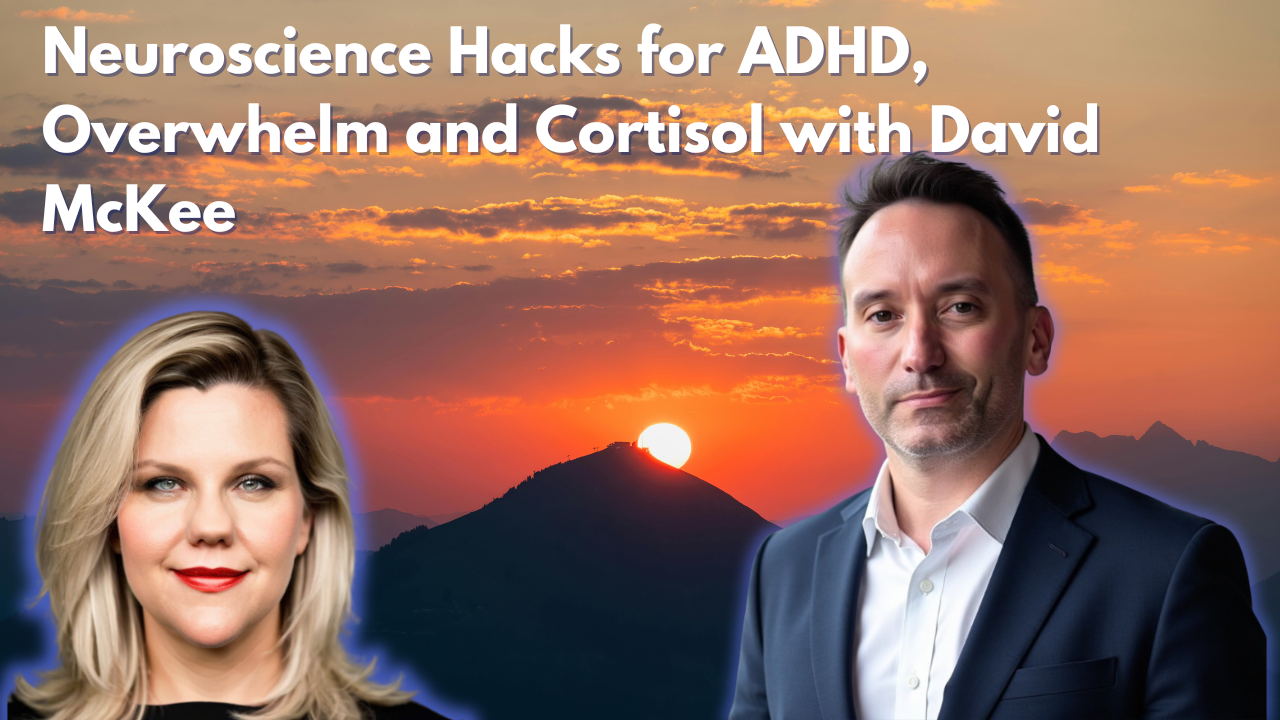
In this insightful episode, Kathy Zant sits down with David McKee, founder and CEO of Another Angle Consulting. Drawing from his own journey through family trauma, a late-in-life ADHD diagnosis, years of high-cortisol burnout, and personal breakthroughs, David shares how understanding the “backstory” behind people’s choices can foster deep empathy and healing.
From reconciling with his father’s mental health struggles to discovering neuroscience-backed tools for managing overwhelm, he offers a compassionate look at why we react the way we do and how to break free from reactive patterns. We explore practical strategies like priming your brain for success (inspired by Tony Robbins and Neville Goddard), the power of finishing small tasks to unlock flow for ADHD minds, capping rumination at just five minutes, lowering cortisol through mindful resets, and shifting from “life happens to me” to “life happens for me.”
David also opens up about the importance of authentic connections, curating your environment to reduce noise, and embracing emotions without letting them derail decisions. Packed with hope, science, and real-life wisdom, this conversation is a must-listen for anyone navigating mental blocks, emotional turbulence, or the desire for more peace, productivity, and purpose in their life.
Watch on Spotify.
Timestamps
- 00:00 Intro
- 00:22 David’s Personal Journey
- 01:38 Understanding Mental Health and Choices
- 09:49 ADHD and Personal Insights
- 16:26 Living from the End and Positive Thinking
- 26:19 Managing Cortisol and Stress
- 30:18 Understanding Emotional Reactions
- 31:20 Managing Stress and Conflict
- 32:28 Personalized Client Strategies
- 33:08 The Power of Authenticity
- 36:17 Navigating Negative Beliefs
- 44:33 Breaking Negative Cycles
- 47:48 The Importance of Positive Relationships
Links
Transcript
Welcome back to Zantastic. Today I am excited to introduce you to David McKee. He is the founder and CEO of Another Angle Consulting. He helps people break through their mental blocks, rebuild their productivity. And basically step into the best version of themselves no matter what you’re dealing with.
Burnout. ADHD. What makes this episode so special is David’s personal story and his openness about it. He grew up in a difficult environment, battled depression, bipolar disorder, ADHD, years of just high cortisol living. I know a thing or two about that. And so we talk about how to get through these types of blocks.
He is very well versed in some philosophies based on Neville Goddard, and we follow the same teachings, and so this conversation really hones in on how to live your best life from learning from people who have done it. And David is one of those. I know you’re going to love this conversation. If you’ve ever felt alone in your struggles, questioned why certain patterns show up in your life, these neuroscience backed ways of dealing with high stress, finding greater joy are things you can start using right away.
Kathy: David McKee, thank you so much for being here today. I am delighted and excited about this conversation. How you doing? Thank you so much for having me. I’m, I’m so excited to be here and ready to get our conversation on. Yeah. Great. Well, um, we did have a little conversation a week or two ago, but give the audience just kind of a background of who you are and what you do.
Sure.
David: I’m the founder and CEO of Another Anglo Consulting, and we consult and we help businesses as well as individuals. People going through mental health blocks, anything where they feel not productive or not as productive as they used to be, and we help them get back on, on track and into the best part of their, their life.
Kathy: That’s amazing. What got you interested in this work?
David: Sure. Um, so growing up, my dad was diagnosed late in life, unfortunately, after he made a lot of mistakes that broke up our family, with manic depression and bipolar disorder. And going through that, it really opened my eyes of, man, things can really hit you differently.
And for, at first, I held a very normal response of the anger and resentment of why me? How could you do this to us? How could you do this to me specifically? And as I got older, I realized it wasn’t about me. He was just someone who was scared in a bad situation and made a wrong choice. So a couple wrong choices.
And when I was able to break it down in that aspect, I thought of what choices he was making and what, what the issue was. He had three kids wasn’t happy in his job. Had his brain kind of going all over the place with his body, didn’t know where he was. He was on certain medications and he’d fall asleep for 48 hours.
He was just not okay. Mm-hmm. And it was being in there that has to be scary enough as it is if you’re not, if you can’t feel yourself. And then from on top of that, having all this pressure of really major life decisions he had to make and just didn’t go the right way. So we were able to reconnect later in life and that really opened my eyes to what psychology neuroscience can really do of, if we can understand why people make choices, it really disarms a lot of the trigger and the negative kind of explosion that can happen behind what happens. Most people are very reactive to the choice you make when you realize, okay, what was going on behind the scenes? I mean, I always use the example of when you watch movies and they show the villain’s backstory, and then people start then sympathizing with the, it’s like if we know where someone’s coming from, it’s a lot easier to kind of make sense of.
Oh, that’s why they did it. It’s not always as simple as black and white and you just are forced into a corner. It’s usually something that you store a lot of emotions. You’re not letting stuff out and then it blows up at the wrong time. And I think we’ve all been there where we’ve sent the wrong text or said the thing we didn’t mean to say when we’re really angry and.
So part of the things that I do within coaching now is teaching people that very being able to notice that of when you do start having those heightened levels of emotion, whether it’s anger, resentment, sadness, frustration, and being able to walk away and not make a, any major decisions. Write it down if you’re thinking of making a decision, come back to it when you’re calm, cool, and collected, and see if it actually still makes sense.
Kathy: Yeah, what a gift that you had the foresight to be able to like come back to your relationship with your dad with knowledge, compassion, empathy, sympathy for where he is.
’cause so many times as kids, you know, well our parents are almost deities to us. They can do no wrong. And when they do do wrong it, it’s hard to make sense of that. What would you say to maybe like a younger person who’s gone through it with their parents, like how do they get to that point of being able to understand their parents and that they were doing the best that they could with the cards that they had?
How, how can somebody look at their relationship with a broken parent in a different way?
David: Sure it’s, it is being able to analyze what is upsetting you. If you can diagnose that first, and then where were they when they made that decision to essentially upset you of if you could break it down to its simplest core, it’s usually something as simple as that.
And we tend to react when we’re angry. We think the craziest thoughts and sometimes those crazy thoughts slip out. I have the conversation with people I’ve started doing this to. If this is like, I know that that’s me, that I’ll, I’ll say that type of stuff. I think like my mind just kind of goes crazy.
I’m ADHD, and like it just kind of starts going into that route and I let people openly know, hey, if I ever say something in that state, especially people close to me. I mean about 0.5% about, like, I, like I, it’s something that I regret later, but in the moment I’m like, I’m just, my mind’s kind of feels like a tornado and I only say what I can get out.
So it’s finding was, was it okay if it was something that you said that hurt somebody, I get into, did you really mean it did Like, like where was that coming from? Why did you say it? And just start the conversation there. If you can start talking about it. Breaks it down and, and in a lot of cases, some people don’t know until they’re actually questioned about that of like a, a lot of us, like when I, I talk to people, especially people who are the ones who’ve hurt others, I get back into it and I, I ask that and I’m like, did you ever intend, would you have said that if you knew it hurt them?
And they’re like, oh, no, never. Like I, like my dad openly said how much he loved me and I loved my brother and my sister, and he never wanted to hurt us. He was doing everything to try to be the perfect dad. And by doing that, it forced him into this level of something that he wasn’t himself, he wasn’t being authentic, and then he lost sight of himself.
And that with mental health disease, like it will just take anyone. We all have that issue. I, I think social media kind of gets into it a lot now too, of having that perfection of everything is perfect. And if you have a bad day, like, and you go on social media and you see everyone around you is having perfect, everything’s great. It, it messes with your head and it really can like, affect you to a negative extent. So it’s, it’s finding those things, having people that you can talk to the about it, of about your insecurities. For the longest time I held stuff inside. I thought I was weird, I was different.
And. It turned out that I was later diagnosed about five years ago with ADHD, and I’m like, oh, that’s, that’s why I was like in that. And it’s, um, I wasn’t that different and I wish I talked about it more because I would’ve felt more as a group. ’cause I know other people have different levels of ADHD and it was, for me, it was just something I felt so alone because I was like, I don’t know anyone else who understands this.
And then on the outside, everyone said I was so happy I was. Like I, one of the happiest people they know, they always got light from me. They always felt that. So I’ve always had that type of pull. But man inside, I was tortured for years and it was just, it, like for anyone who didn’t really get the chance to know me or talk to me or see me at that level, they would’ve thought everything was great.
So I, I wanted to start spreading the word on that because. Yeah, it’s like I think a lot of people can feel alone, especially now more than ever, post COVID. And if you start having that conversation, there’s so much more in community and so many people, the more I started talking about this have reached out and they’re like, me too, or My kids are dealing with this, or my this is the issue I had with my parents.
And man, it’s, it’s opened up conversations to healing to let people kind of understand each other better. Society’s gotten so much into a finger pointing society of you’re wrong because of this, or, or score keeping, I like to call it, of you’re, you’re holding up everything someone did wrong.
And I always say, man, like if, if you’re doing that, like if you’re a couple and you’re doing that to each other and you’re score keeping of, you’re, I’m gonna bring this up when we fight next. And it’s like, I, I know people who actively think like that. And I’m like, man, you just don’t get anywhere. That’s a one way ticket to disaster because no matter who’s looking at it.
Whoever, whatever frame you’re in, if it’s me, I think they wronged me more. And if it’s them, they think I’ve wronged them more. And it’s like, and it’s purely that level of not understanding of where were they coming from, from all of it. Because that makes you help make sense of a lot more. And so if you could start having that conversation, long way to answer your question, but just start talking about it of like if you do have something that makes you feel different, like feel not good or like unsafe, anything like that, especially with family.
Talk about it because man, the, the people I know, especially within my family, when I said, Hey, I felt this. They’re like, oh my God, I would’ve turn the end of the world to not let you feel like that if you, if I had known, and it’s a lot of that, of we, we think it’s weak or we don’t wanna like open up, especially as a man growing up, I was always told to bottle my feelings.
So doing this the last couple of years and, and getting onto podcasts and like, kind of spreading the message, it made me realize, man, I was doing it all wrong of like, I, I feel more connected with people more than ever and that other people who understand what I’ve been through and that it just, it lets you have a community and lets you kind of feel like you, you’ve got something bigger than what you just are.
Kathy: Yeah. Yeah, that is such good advice. I wanna ask you about ADHD because I’ve known, I know one person who was actually diagnosed, but I have suspicions of a couple of other people who have been in my life. Mm-hmm. Um, but they were extremely high. Like when they were on, they were absolutely completely and totally brilliant.
But there, there was almost like this darker side where, you know, things would just not be okay. Yeah. Talk to me a little bit for, for somebody who doesn’t really understand ADHD, what is it like? What is it like having A-D-H-A-D-H-D?
David: So it could be the biggest blessing or biggest curse based off how you treat it.
And, um for me personally, and I, a lot of people I know relate to this as well. It’s a little different for each person. Um, it actually comes from not, not much genetically. Gabor Mate went into it in Scattered Minds, his book that it was, it’s presented by, if they were stress in both parents before you, before they had birth with you.
You’re likely to have some type of ADHD to some extent. Just stress in the family because that the way that affects the blood. And then, then you come out that you’re a byproduct of stress and cortisol. That, so you have heightened cortisol right from the start. But then other aspects that I’ve gone into is the, for me, I need to finish a pattern.
I need to see something end for me to kind of get my brain into motion and get into flow state. So I highly advise anyone who kind of make your bed in the morning, do laundry, do some simple tasks that you can start and finish quickly, and it, it gives your brain almost a cheat code of it seeing things go right and things get finished to start the day.
What is chaos and can drive me to a level where I just am so unfocused and scattered is when I don’t get to finish that and I’m constantly interrupted and I’ve got 18 different things kind of in motion and I’m not able to finish one at any given time. And so that’s where it will literally throw me off and I’ll be as unproductive as possible. And I’ve been able to kind of tap into it that.
If I’m on and I’m focused, locked in, I can do about eight hours of work in about 90 minutes to 120 minutes, like an hour and a half to two hours. My brain gets into like this hyper mode that I can really think and I go, but if I’m not in that state. I could be literally that I can sleep for eight to 10 hours when it’s not time to go to sleep at night.
It’s just like in the middle. I could just pass out for hours on, on end. And it’s just that the brain needs either deep engagement or deep rest. And if it’s kind of like stuck in the middle, you just feel like your tires are spinning and it’s just kind of like you’re spinning out and you don’t really have a way to kind of finish whatever you were starting.
So, for me, I went through about two years ago. I was in Florida for a trip. I was in a career transition going through some change, and I felt so stressed when I got home off the flight. I get home from Florida. I, I was so relaxed on the trip and I am just, man, I’m like in a stuck kind of status. And for whatever reason I’m meditating and I get just this intuition and this voice kind of like clear voice that I hear just says, clean your house, Dave.
Clean your house, and I didn’t know what to do going into that. And then I cleaned for about three hours and I think it was probably like a, like a true spring cleaning. Like I, I did everything. Got, got all that done. And then I had two songs that came to me and then a business idea that came to me. And it may not seem related, but if you can finish something and get something and not have a, like, you can’t really have scattered messes in your house.
My teachers called me, growing up, messily, organized. I knew where everything was, but it was all over the place. And so I had to really change that because I was. Really kind of triggering myself if I, if I left messes everywhere and I came home to it and I didn’t wanna clean it.
And so like, you’ll see that a lot, especially with ADHD of people doing laundry is it will take them two days to do the laundry that they do part of it. And then some of it’s just hanging out and like stuck there. And that’s a really like very, very common symptom of most ADHD of, they start a whole lot of things and they’re very, very smart and en and engaged and excited.
Until they’re not. And usually it’s, they’re not because stuff isn’t getting finished and they don’t see that end goal. So the creation process is very exciting for a lot of people with ADHD. Mm-hmm. But then the actual, seeing it through, you need to be disciplined because otherwise it slowly starts eroding at you as you go through.
Kathy: Okay. So they really need to have, they need to know what’s, what the purpose of the work is and what the end kind of looks like.
David: Yeah. I mean, it’s, so for me that, like I always say, start with something simple, because seeing something from beginning to end, it, it gets the brain working. And Tony Robbins talks about priming your brain.
Mm-hmm. So if you’re priming your brain and you start a whole lot of stuff and it doesn’t finish. Yeah, we all have those internal limiting beliefs, negative thoughts that kind of roll through of you’re gonna fail. You always fail. This doesn’t work. It never works. And like that, like kind of in inner dialogue that a lot of us have on the negative side.
So when you’re starting a lot of stuff and then it all kind of pauses. And it’s not being finished. That’s what starts running your, through your head on a loop. And it becomes a lot more real when you see, oh, there’s all these things that aren’t being finished, where in reality you started a whole lot of stuff that most people couldn’t do.
And it’s, so, it’s, it’s that kind of frustration in the back and forth and having someone to talk to when you’re going through it and, go through that side of. For me, my wife when once we met is I talked to her and I’m kind of going through that and she kind of helped me work through. She doesn’t have that at all, but she knows for me, talking it through, I can kind of start getting to the end of, okay, this isn’t that bad.
I like, I sell bookwise and I’m like, oh, if I just do this, I can get this one done. And it’s just that thought process of getting the thoughts out loud. That really can kind of trigger that. Like get your brain working and, and what we were talking about priming before, priming your brain so that you do see something finished.
Because then once you see one thing finished, your brain is then focused on how do I finish the next thing instead of, you start a whole lot of projects, you’re in the middle and it’s, how do I finish this? And I, I can’t because I, I’ve got this other thing to do and this other thing to do and it, so it’s, it’s just literally that side of it of how can you make it as easy as possible?
Finish one thing at a time. You get the confidence and you get that feel of, oh, alright, this isn’t that bad, this is easy. And it literally just sets you up for success compared to being stuck into that kind of back and forth and really just stuck kind of mode.
Kathy: Gotcha. Okay. So if, if you, if you start a project and you have like, okay, this is gonna be huge, it’s gonna be, and you get really excited about it, I assume ’cause it.
Get a picture in your mind, but you start getting towards the end and it doesn’t feel like it’s going to match that initial picture. Is that a de-motivator as well?
David: It, it is, it used to be for me. Okay. And then I got, I got really heavily into Neville Goddard on this going, going to psychology and all that, and living from the end of,
Kathy: yeah.
David: So for me, I, I really do believe. We get that feeling from, and, and you get some people, some people will tell you it’s a different timeline or it’s a higher self of you, or it’s you in the future. Like what, however you wanna kind, kind of term that. But when you get that excited feeling and you feel, feel it, so just so insane.
Like you feel that joy, you feel that happiness, like, oh my God, this is like just eyeopening. That feeling is there for a reason and it’s remembering that feeling when you have those, like I write them down, like I, I journal like, hey, I started this project and I had the best feeling about it. Like I try to like relate like when else did I feel like this?
And it’s remembering that and going back to it because we don’t always get those really, like those bits of just genius or bits of like something that’s really gonna push us along. So when they do come along, I wanna remember it for the good of how great I felt instead of, oh, I, I had this great idea and I just wasn’t able to execute it.
And like down the line, like, you forget that good feeling because if you didn’t finish it, that’s where you kind of get into those cycles. So if you can’t finish it, it’s like, I love to live from the end, as ne Goddard said, to figure how it can all go right. For the longest time I was stuck in a negative loop pattern.
And our brains, by the time we’re 35, about 90 to 92% of most people is automated. You’re in the default mode network of your brain and you’re doing the same things over and over again. So if that inner dialogue is very negative and like has limited beliefs kind of scattered through there, and that’s what’s running all the time, you aren’t gonna finish a lot of stuff.
You’re talking yourself out of it. And that’s, I, I’ve seen some of the most brilliant people have the most, the best ideas that have come out. Apple like Steve Jobs used to talk about all the time, he almost quit multiple times. And it’s like that, that was, he’s no different than us in that aspect.
We have that kind of pull of, maybe it’s just easy to drop it all from right here. So usually when you feel that little bit of a pull, you’re, it’s the whole, um, if you’re hiking or you’re climbing a mountain and right before you reach the summit, your legs feel like they’re gonna give out and you wanna quit because like, your body’s almost like trying to quit on you.
And it’s usually when you have that feeling, if you can notice it, just keep pushing forward because you’re very close is that you’re the, what your body is giving you. That visceral reaction is, this is change and it’s not familiar and it’s just automatically lumping as anything changes scary or that your body doesn’t feel right.
So I’ve learned to embrace, when you have those feelings, it’s usually something pretty great. And if you could just tough through what you’re going through, see the end of it, then you realize opportunities start coming. And I’m like, man, if I would’ve quit that opportunity, 2, 3, 4 never would’ve happened because I just would’ve closed it off in my mind and it just wasn’t interesting to me anymore. So yeah, it’s finding that, that brief, those bits of when you feel that joy, when you feel something pulling, you lean into it. That’s your intuition telling you that something there creatively is, is going for you. And the more you can tap into that, the more you can really listen to yourself and, and find what’s best for you.
Kathy: That’s brilliant. Yeah. I loved Neville Goddard. There’s so much wisdom in that, that whole idea of feel it real and
David: mm-hmm.
Kathy: And just ending every day with a vision of what it is that you would like for your future, and kind of like communicating that to your unconscious mind as you’re drifting.
David: Yeah.
Kathy: Every time I go to bed, I’m like, all right, now’s the time. Now’s the time. Then I’m, boom, I’m out, and I’m like, oh, wake up the next morning. Okay, well, we’ll try again next time. Can you, do you do that? Do you do the whole life? You’re drifting off to sleep like visualization?
David: Oh, yeah. Yeah I do the Tony Robbins priming every morning, and I, you do do some type of meditation at night that I do visualize what I want to do.
So I’m big about, um, especially, so it’s a neuroscience hack that why when people say, when you first wake up, go to the bathroom and say your affirmations. The science behind that is that your brain is still in a partial mode, that you’re very suggestible to your subconscious and they say in those, the first 10 minutes that you wake up and the last 10 minutes right before you go to sleep, that your brain is in that most kind of suggestible mode outside of when you’re, that’s the only time you’re awake, that you’re really that suggestible.
The rest is when you’re sleeping. Yeah. So if you can really use that time to your advantage, not be on your phone, not be looking at stuff that’s gonna stress you out or worrying about what, and most people worry about the future. So they’re looking at their phone if they have a big meeting tomorrow and oh my God, it’s gonna be so stressful.
And that’s what they’re priming their brain of how they’re gonna wake up and then they wake up stressed and live stressed. And so it’s finding that. I, I walk through, if I have a big meeting going on the next day, I did this for this meeting. I, I wrote out how everything could go right for this podcast of what I wanted to talk about or what I hope to talk about.
And it’s just, it’s a better way of living. I still do look into the negative. I, I try to gauge what’s right for risk and, and what, what will help me. But what I really started leaning into was what if it all goes right? I, I obsessed forever of how everything could go wrong and never really thought of how it could go.
Right? And that’s part of the equation too. So if we are going through, I, I actively tell people, you don’t need to be toxically positive and, and just super positive all the time. But what you can do is start literally looking at both sides of it. We worry ourselves sick about how it could all go wrong.
Think maybe for a little bit of that, how, how it could all go, right? And if your brain starts seeing that we have the reticular activating sensor in our brain, the RAS, and if we. It’s how it’s focused on something, it’s gonna look at it. And, Tony Robbins does a really cool trick often that he’ll say, look around your room.
Take a, take a quick stock and find me everything that’s red, red, red, red go through. And he says the word red over. So he is prime in the brain that you’re go looking at red and then when the person stops, he’ll say how many brown things did you see when you looked around and their, so their focus got so little that it was everything was like looking on the red side.
And then he had said, I’m sure then your brain to give yourself that dopamine. Looked at some things that were brown and maroon and tricked yourself. Say, well, that’s kind of red too and like, like to just kind of give you more of that. So our brain is looking for that actively, and a lot of cases, what I find within people is that we have a very negative mind pattern.
I own it myself. I had it and I’ve worked to switch out of it. And it’s what I coach now is how can we notice what the thought pattern is if it is negative. Diagnose it, talk about it, and then slowly rework things so that we can think a little bit more positive, stop us or stop ourselves in our thoughts so we don’t go on a train of just negative thinking, going down rabbit holes, the way people talk about it.
And I’ve gotten to a point where like, sometimes something will upset me and it’s for three to five minutes, and now I can, I can cap that at five minutes that after that, I’m like, all right, I, I’m feeling sorry for myself. I’ve learned the science behind it. It’s wasted energy. You can ruminate and be as sad as you want for five minutes or 50 days and you’re gonna, your brain is looking at the same way. You’re just putting yourself through a whole lot more stress the longer you do it. But it’s fine to feel something. I tell people all the time, anger, sadness, emotion, feel it all you need to, but then come out of it, okay, how is this working for me?
It’s why is this happening? What’s going on and how can I make this a positive of what I’m doing? So I, I really believe if you can flip the script of life happens for me and not life happens to me, you take a lot of power back. Yeah. And you start realizing there’s a lot more in your control. And I, I, I love to use this example of when I was a teenager in school, I had really big dreams and, and all these kind of things that I was looking forward to. And my life has turned out a thousand times better than I ever could have expected as a kid. And I’ve gone through some of the worst things. I think people could go through traumas and, and all that. And I look back, but I wouldn’t change a thing. And I really look at it. I’m like, man, I, I’m grateful for the things that, the negative things that have happened to me because I’ve really been able to turn that into, I have this confidence that no matter what kind of setback I have, that I always come out better for it.
And that’s been the story of my life. If you’re looking for the positive, that’s what you’re gonna keep drawing to. And for me now is when I have some of this friction or something that doesn’t go the way that I expect. I almost, I like, I think it’s a, a Kabballah type teaching that was they talk about your vessel and they try to say outwardly that you say, God, what a pleasure.
You’re sending me problems. Send me more. And it, it’s kind of like that mentality of if you can go in with that type of mindset. It helps you switch it. And I like to use a lot of different spirituality. I come from a Christian background that my dad was a minister and I wanted to learn one of the coolest things that my, both my parents passed on to me was they told me never to be scared of other people’s religion.
That if someone believes in something bigger than themselves, they’re on the right path in life that they like. They’re trying to do something better. They’re trying to be a better person than what they are today. And they said, and they like encouraged me, don’t not talk to the people, like actually actively talk to them, learn about that.
So I’ve got friends who are in religions of all backgrounds and like learning about the Kabbalah, I was just like, man, a lot of that is all about like that our body is a vessel and what are we doing to either expand our vessel and make it as big as possible to help. Or are we doing stuff to constrict and shrink in our vessel?
And it’s, you can really like kind of look at that in so many different patterns and ways. But I’ve really looked at, okay, how can we really just jump in and be the best version of ourself and what are we dealing with and what are the decisions we can make to really put us on a path that gets us to where we wanna go instead of this constant kind of cycle of always feeling uncertain, not sure what’s gonna happen, and feeding into a lot of the things that are making us more stressed. And that stress on stress is just really causing more and more issues within people. And you’re talking about sleeping patterns, sicknesses, illnesses, that’s when it gets into epigenetics is the more negative thoughts you think and the higher your cortisol is, it can literally shut off gene receptors in your body.
That could be something that’s fighting off a disease for you. So it was really a mind opening thing for me when I saw your thoughts can make you sick. What’s the flip side? If you, if they can make you sick, they can also make you better if you think about it the right way.
Kathy: So true. Yes. Cortisol is my enemy.
That is, I’ve, I’ve been fighting with cortisol over the past few years and I’ve finally like, all right, I’ve got you figured out. Mm-hmm. So that’s like my big thing that I’m working on is keeping the cortisol low. What’s your advice for that?
David: Ooh. So for me, I, I’m, I’m still getting there. Yeah. I like, I’m, I’m so much better than what I used to be.
I can cell phone that. I, until I met my wife when we were dating, she taught me how to relax. I, it sounds very simple, but I couldn’t relax. I was always thinking what was happening next? What work was happening next? I was a workaholic. I was so into that frame of mind that if I wasn’t grinding, I wasn’t doing something right.
Mm. And I had to unwind from that because it just wasn’t healthy anymore for me. And I realized, you can make money, you can be successful and do it on these terms, and I got, I got big into frequency of if you’re vibrating at a higher level and you’re happy and you’re positive. More happy and positive seems to attract more happy and positive people.
Where negative and sad attracts a lot more negative and sad people. And so I realized a lot of what I was doing it was brought on by the way I thought, and the way I felt and the way I thought life should be. So I thought you needed to grind to like work 80 hours a week to be successful in life. And I wanted to.
Make the most money that anyone ever made in my family. And I had like, all these just heightened expectations. And I made myself sick trying to reach up to that because I was a perfectionist. I thought that that was like a badge of honor that I was wearing. And I look back now and I’m like, I, I just, I can’t believe that I used to think that way, but I saw why I always had, I mean, I had stomach issues all the time.
I didn’t realize it was anxiety. I just thought it was just something that was passed down to me. And crazy enough that I’m doing more work than ever now, and those stomach issues are completely gone. The sleep pattern issues that I had, that I, I, I mean, I was on Ambien for years because I couldn’t regularly sleep.
It was cortisol. It was nothing at all that I couldn’t sleep. I, and part of it is ADHD related. This is a symptom as well as I tell people, you probably should go talk to a doctor about it to get treated, if when you lay down, it feels like you’re turning on a computer and then your mind races and then you’re just up all night.
Mm-hmm. Part of that is cortisol, but that’s also an ADHD response to the T of your body’s finally in a relaxed state and it doesn’t know how to relax. So then the brain goes into hyperdrive and it’s, it’s wild. But that was me for the longest time and I. I now go, like, I realize how much I need to meditate and just literally get back to a center.
And I, I always tell people you feel usually anxiety in your chest to some extent that you, like, you feel that rising going from your stomach up of when like you’re getting, man, you’re getting mad and mad. And I’m like, when you start feeling that, that’s when you take a walk, you gotta get away. It’s like, it’s like your body’s telling you that that heat is rising and how, how do we move around it and get going?
Um, and yeah. So it’s, it’s really finding that. And then also, I mean, very simply, we live in a cortisol lead society. Of you, you watch the news there, there are words, no matter what side you’re on, you watch, if you’re watching consistent mainstream news in America, you’re, you’re getting a lot of, this is terrible.
This is awful. Everything is like the world’s coming undone. And it’s like that kind of thing that affects people that, like, if that is always in your face constantly and then you look on social media and everything’s perfect there and you just, you don’t know what to think. Your, your, your brain and your like, like just whole mindset’s kind of in chaos.
So it’s really finding out, like I, I tell people all the time, especially on the cortisol side, what’s in your Instagram algorithm? Is it stuff that you all like and makes you feel uplifted? And if it’s not, change it. And like that Instagram instituted a new thing, I think like a couple months ago, that you can actually reset your algorithm.
And I actively tell people, I’m like, if there’s stuff on there that’s stressing you out or getting you kind of amped up to any way that’s not healthy. Ditch it. It’s like that’s, that’s truly, a lot of people go to their social media to unwind for a couple minutes, and I find a lot of ’em, they’re getting more stressed out by actually going on it.
And like, the more time they spend on it, it’s worse for them. It’s that whole RAS thing coming back with the brain. What we see and what we’re filtering is part of our human experience on every day. So if we’re seeing a bunch of stuff that gets us angry and then we’re watching the news and that gets us angry, and then we are at work, something doesn’t go right and the cortisol is coming out, bad decisions are gonna be made.
It’s kind of like gonna be in the equation to some extent. So it’s how do we limit that? And I, I’m very realistic of, especially because I was someone that I thought this stuff was an on off switch. Anytime I had a anger or reaction or frustrated reaction, I thought it was weakness and that I wasn’t doing what I should be doing, and like I was like, all right, I’m not doing it right.
I’ve gotta retry because that didn’t work. And anger and that those emotions, it’s not an on off switch. Feel them. Let the moment happen and then actually write it down, go through. Then when you are calm, like we talked about earlier on, when you’re back in that calm state, does this still make sense?
Because if it does, then okay, then it, it’s a decent thought, but it’s, it’s no different than our bodies are comprised of water, majority of water. And if you have a stainless steel pan and you put water in it, you can see your reflection when you look down into it. Right? And I always use the pasta example, so I’m gonna go cook pasta.
You can see that. So then you heat the water and then it starts boiling. You can’t see your reflection anymore. When it’s boiling. The water is taken on a new composition, a new chemical structure, and it is heightened and it’s different, and that’s what we are when we’re angry and there’s no shame in admitting.
Like I got to the point, I’d say like, I know I don’t make good decisions when I’m angry. Let me walk away and don’t press me into one. When I’m into those situations. And when you can have that honest conversation with people, people wanna see what actually is happening out of you. A lot of people think if they don’t get it right now, it’s like a matter of disrespect or anything along that.
Some of our brains just don’t think that fast. Some people are very good of. Going into conflict, talking to people in person. I’m the first person to say, man, when I get into those stressful situations, my brain starts usually is at a hundred miles an hour. It starts going a thousand miles an hour. And any thought I have, if I don’t finish it, then I get, it’s that whole, like not finishing a pattern is like I get frustrated if I can’t actually say what I’m saying and in Most cases when people are having any type of conflict or arguing with each other, it’s you talk over each other.
You cut each other off because you, like, you think of this and you want to get into that. And for me, that like, if that happens two or three times, I’ll shut down. Like I just, I can’t kind of engage anymore because it’s just not, it’s, it’s not going anywhere. It’s just kind of talking in circles. And so it’s, how can we unwind from all that and not put the expectation of just because we can get that response outta someone doesn’t mean it works for everyone around you.
So I’ve started asking people, especially when I work with them, if I’m doing any type of client work of how do you respond when you’re stressed out? What, like, are, do you get reclusive? Do you like some people like to be more social, like, like go out and just like kind of unwind and, and have a couple drinks, do whatever, like people have their own kind of response to it.
I really love getting into knowing people and how do you respond to it? How does it work for you? And where we’ve had a lot of our successes, we build client templates that are individualized of this is gonna work based off exactly how you react to things. Yeah. And for me, like I, I did it for myself, the way I react to stuff.
I was like, all right, I found a path and something that works for me, that I can be a hundred percent myself. If we can be authentic, it’s where the magic happens. So the more that we can feel, just that safety of just being ourselves, unabashedly, no problem. It really helps open up all creative kind of minds of what we can do or what we’re capable of, and that’s where intuition really starts speaking to you at its strongest.
You don’t have as much distorted noise going on, so the more authentic you are, the more tuned in. Man, that’s where all the good things start coming in. I, I mean, the ideas that I’ve had and the projects that I’ve worked on over the last couple years. I know, man, I would’ve gotten there a lot quicker if I didn’t have the distorted noise and the stress and cortisol going on all the time.
I have a book coming out next year called Navigate the Noise, and it was all because of that. It was what I went through and then I wanna help, other people kind of get through what they went through or going through. Especially COVD, our attention spans are shorter than ever, and COVID made that worse.
And I know that there are a lot of kids that are in that, like seventh grade to 12th grade range right now who didn’t have a normal childhood compared to what we had. And I would say we didn’t have normal childhoods. So it’s, it’s just, it’s crazy to see what they’ve gone through. And I know, I’m sure that a lot of those limiting beliefs and negative thought patterns are prevalent in what they’re thinking.
If their parents have the news on all the time and they’re looking at these things on social media. It, it. It’s just, it’s so, so much bad that couldn’t happen or can be out there. And a lot of them don’t know that they can look for their good or, or prime their brains to see what they could do. So I want to be able to kind of give neuroscience acts of, here’s stuff you can do.
Like the 10 minutes before, 10 minutes after we talked about, this is stuff you can do tonight. And just try it. And you realize when you start priming your brain at night, I was someone, I was always tired all the time, and a lot of that was that unfocused side of the ADHD of me. And priming my brain at night that I’ll say if I have a meeting, I was like, I’m gonna have so much energy tomorrow.
I’m not. I was like, if there, if something goes wrong, it’s not gonna be ’cause of my energy or because I’m tired. And it’s just having that talk every day of I’m gonna wait when my alarm goes off, I’m gonna wake up and my, my brain’s ready to go. And it’s wild when you can say that and go through that of.
How things start planning out, especially what you can control within your body. I wake up with energy. I don’t have a bad night’s sleep. And it’s all those things people say if you talk to plants, it’s had a reaction. It was that whole rice experiment in Japan. Yeah. Where they took rice that didn’t get touched, and then rice that had water in it.
There was a third example, but essentially the three, what they did to the. The sets of races is that they one said, I love you. One got no talking at all, and the others said negative words to it. And the negative words got nasty fermentation and it like went into this weird kind of state and the one that was given positive words that I love you.
Grew immensely, and the one that wasn’t talked to at all was in between those two. And so it really shows that there is something that when you speak something out loud, it’s magic. It’s you can really, like if you start saying outside and, and really getting that out, it, it can make a huge difference.
And when you start talking to yourself, they say some of the most successful people have an active conversation. They talk out loud on a walk or on a run of, okay, like, like they get those thought patterns going. And so my clients and, and why I started my company is how can we start that conversation?
How can we get that going and how can we really help people get essentially out of their own way so that their best thoughts can come out?
Kathy: Right, right. What do you see with your clients as sort of a common negative limiting belief that most people have and how do they get out of it?
David: So most common is the, like, I can’t, or I, I’m not good at that. Any of those things I’ll rewire just to say. If, if you say, I can’t or I’m not good at something, and I actively catch myself in this twice, this past month I did this to myself and I, as soon as I said, I’m like, Nope, I can’t say that.
Go back. Just say, I haven’t done it yet, or I’m not good at it yet, or I’m gonna be good at it. I’m just not there yet. And it’s all how we kind of talk about. Because of that score keeping and, um, kind of very point finger pointing mentality In society we’re very tough.
We tend to be very tough on ourselves and the way we talk to ourselves and the way we think about ourselves. And, um, it’s one of the things if, if somebody, I, I, I’ve helped people who are trying to get into relationships of like, like not quite a matchmaker, but kind of helping them on that path. Like even to that extent.
It’s a very common thing with a lot of it that I find, and whether it’s relationships or if it’s business that’s holding people back, is they don’t actually like themselves. That was something I can honestly say I used to not, and I think it was because of how I worked myself till I was sick and, and I was doing all those things.
I didn’t really like that and I don’t think I was internally proud of it, but it, externally, it’s what I thought I needed to do and so I, I found that a lot of people have a lot of self-conscious issues of how they look, what they feel like or what, what they think they’re actually doing. And the crazy thing is, is we tend to think of all these things of what people are gonna think about us.
And it’s like a, a crazy number. Like it’s like 82 to 85% of the things that we think they think, never actually even thought it’s just in inside of our own brain. Mm-hmm. So when I re, when I heard that, I’m like, man, that’s a lot of wasted energy and a lot of wasted time. And like, like what? How about we just, so it’s, it’s just the very simple mentality of what do you want?
What, like what do you love to do? Find the hobbies that you love to do. Tap into that. When you tap into things that you really love to do on a day to day, you get more creative and your brain starts thinking in different patterns. And if you can get your brain into those creative patterns that are more kind of open.
I should have mentioned this before, but I’ll add it now with cortisol, is anything that’s cortisol or stress related flight or fright, it, it works that same way. What opened my eyes is when I heard the example of our brain scans when I, my brain scan if I’m stressed, reads no different than an animal being hunted in the wild.
Kathy: hmm.
David: That’s when I knew I needed to stop. I was like, I can’t, I can’t think like that anymore. So like, that’s just not, ’cause I, I thought about stress a lot. It was constant. So if we can kind of realize, okay, like when you’re in that type of brain pattern and to not be as dramatic of the animal hunting in the wild, I use this example, um, when you’re growing up in school, like I, I had to go through this in English history and science class that you would be reading a chapter and everyone kind of takes a paragraph or two at a time.
And it’s just ra, like the teacher would randomly call on the next person. So it happened to me a couple times where I lost sight of it. I stopped paying attention ’cause my brain’s just thinking and whatever other thoughts are going on. And then I get called on and then I’m like, oh God, I don’t know where I am.
And it’s, as you’re looking to try to find where you were in like, like, put the context clues together of how that all worked. You realize your vision is so narrow, you can’t really see what you’re looking for. Yeah. You’re looking at like little sentences at a time and you can’t. So that’s what stress does.
It stress really limits your focus of you, and when you’re cool, calm, and collected, you’ve got an open focus. You can kind of see the entire room. It’s not as stressful. , You’re in more of that control, confident type mode. Yeah. So it’s, I, I, I always work with how can we get people to that confidence level as much as possible. All the time is impossible. It’s, it’s like unrealistic, but it’s how can we do little things on a day to day, not change your schedule much and really tap into how you can feel those good feelings and feel that confidence and see the entire room. It just opens up so many more views. And I, I tell people a lot, you’re not far away from your best life, your most abundant, richest, wealthiest life.
A lot of people, it’s just your vision is so narrow, the opportunities are there, but your vision is so narrow, you just don’t see it. And as you unwind that stress and you really start looking towards that more positive, what works for you? You see stuff, and it’s crazy how opportunities start coming in.
The same opportunities would’ve been there, but you just really were kind of closed off to it energetically. So it’s, it’s a way that you can really tap into your best self. And I always say the opportunities are there for all of us. It’s how much do we really wanna engage in that? And how much do we wanna open our scope of you so that we’re open to it.
Kathy: Very, very good advice. Yeah. My husband, my husband was neurolinguistic programming practitioner, but he used to always say that when you’re under stress, you’re, you’re, well, when you’re not under stress, you can take in about seven plus or minus two bits of information at a time. That’s what your RAS can actually, or a reticular activating system can actually get.
But when you’re under stress, it’s one or two. Yeah. It’s just that narrow focus where you just like lose sight of what your reality really is, and 90% of the times you’re losing sight of how life is really working out for you and you’re focusing on that one or two things that are stressful to you and it just compounds.
Mm-hmm. And, and you just. Keep rolling down that hill, like a giant snowball into a place where you don’t wanna be. Right. So,
David: yeah. Yeah,
Kathy: yeah. Yeah. It’s crazy. You’ve mentioned Tony Robbins, have you ever been to one of his events?
David: I have not, no, but I’ve been to other seminars similar.
Kathy: Yeah.
David: But it’s Tony Robbins definitely one of the ones I wanna get to. It’s yeah, I’ve a lot of friends who’ve done it and said nothing but the best things.
Kathy: I was gifted the ability to go to just the online version ’cause travel’s been hard for me, but the online unleashed the power within. Mm-hmm.
And I was like, all right, well I’ll go, I’ll, I’ll go see what this is all, you know, a little bit skeptical of like, but, but they said at the beginning, like. Play full on, like participate, and I’m like, well, I’m here. I might as well. Yeah, I got more out of that experience. It was just really well designed, very, very well designed, so I, I highly recommend it.
It’s definitely. Yeah. And a lot of the same things that you were saying of, you know, people’s negative thoughts are always sort of like, I can’t, or it’s not gonna work out for me. And just like this negative self-talk that that’s going through, you know, you have to look it in the face and really kind of like.
Well, he did this one exercise where you have to take it to the nth level. Like, okay, it’s really that bad, right? So like, let’s go, let’s go all away. Like, what does this mean? What does this mean? If this is true, what does this mean for every aspect of your life? And where are you gonna be in five years if this is true?
And then you’re like, well, screw it. That can’t be true.
David: Yeah, yeah. Yep.
Kathy: And you just start letting go of like a lot of the negative self-talk, because it just becomes, first of all, kind of ridiculous, but also like, oh yeah, no, I, I, ’cause mine, one of mine and it was like negative self-talk of I can’t and all of that stuff.
Mm. And you know, I mean, I took it to the nth level and I was homeless on the streets. And it’s funny now if I drive by a homeless person and then it just, like, I kind of laughed to myself. I’m like, that’s where I went with that. It’s so ridiculous. So,
David: yeah.
Kathy: Yeah. I mean, it cha, doing the work that you do with clients, very similar to what Tony does.
It just. It’s so simple, but
David: mm-hmm.
Kathy: It’s like something you can’t really, you can’t really do for yourself. I don’t think it’s, that’s why I think coaching is so important. Um,
David: yeah.
Kathy: Doing it for yourself just takes so much longer and you really shortcut it for people, don’t you?
David: It’s, that’s the goal. And I mean it, to put it in really like simple terms of what we do is.
Where intention goes, energy goes. It’s like, what, what we’re thinking about, that’s where your energy is. And in a lot of cases it’s people are really great at what they do at work, but then when it has to come to that same, like, whether it’s scheduling, prioritizing, they’re great when it, it comes to work, but then they just wanna turn off when they get home and it, it’s not that same type of energy.
A lot of people will kind of sell you, oh, if you change this and you do this, then like, everything changes. And I, I always say like, what are we dealing with, especially like within this situation not make major changes up too crazy. But to kind of give a little bit more about where, where there’s negative loop cycles start.
And I think a lot of it’s just almost priming of like, we, we get into that, you’re hearing that negative news constantly. And then if you’re in those mode of like majority of people that like 90, 92% of what you do is automated. You’re going to work. And it’s usually a job that people don’t like and it’s, or, or that stresses them out and then they come home and they do the same routines just to kind of get through and they’re like, people talk about the whole phrase working for the weekend, so you’re going through five days of whatever just to get to two days.
And for me, like I, it, it took another example, but I worked on a music album that I was really excited about a couple years ago and it was so exciting. February they announced the track list. So I’m, I’m, I couple my songs on there. I’m excited. I’m, I’m really just all pumped up. My birthday’s at the end of March.
I don’t remember that birthday and I don’t remember, I can’t really tell you almost anything that happened between that March and October. It was really great when it came out for about two weeks. And I looked at and I was like, I just traded like seven months of my life for two weeks.
And in reality, when you do the math, it’s very close to if you’re trading five days for two all the time. And it was just one of those things that I realized, man, I’m, I’m wishing away time. I was wishing away time, and, mm-hmm. It’s, it’s, a lot of us don’t even realize we’re doing it. And that’s where we fall into that default mode network that , we don’t even realize.
And Joe Dispenza talks about a lot that people get addicted to lives they don’t even like, and it’s a scary thought, but it’s like you go through that and you’re working for the weekend and then you’re stressed about what’s gonna happen at work tomorrow. You’re looking at your phone right before you go to sleep.
And then the first thing you do when you wake up, when your alarm goes off is you look at your phone and you go right back into your emails or texts or whatever that was stressing you out beforehand. So you’re priming your brain that you went to sleep, that it’s gonna be stressful and then you’re waking up that it’s gonna be stressful.
And that’s why I say you get into those loop patterns. Where you can break that is how, how can we put the phone away for those five to 10 minutes? Yeah, before you go to sleep and when you wake up how can we, like, I, I, I say the ma most basic, if you brush your teeth teeth with the same hand all the time, do it with your other hand.
See how hard it is, muscle memory wise. And it’s, you realize that your brain is, is gonna pay off. Like if you drive the same way to work every day, pick a random day on Wednesday and go a different way. And it’s little things like that of your brain expands so much with neuroplasticity when you do something new, especially when it’s something you don’t wanna do, when you force yourself into stuff. And sometimes you’ll do it and you’ll be like, okay, it’s not for me.
But you tried it and you got over that hump. You didn’t just assume. So it, it’s really falling into that of how can we like go with our brains. And our brain, like we’ve got neuroplasticity. I think it’s to like 75, 80 in that ballpark. So you should be playing those games with how can we switch as much as possible?
Yeah. I know with my grandparents as they got older, they did kind of the same stuff all the time, every day. It was a very routine kind of nothingness to some extent, that was kind of going on. Do you wanna live that way or do you want that? And a lot of people are living like that as late teens into early adults into their adulthood, that same way of that it’s just this like, life isn’t great and you’ve gotta go through a lot of crap before everything gets good. What I found is if you’re into that mentality, it’s usually a lower based frequency mentality. And when I say lower based frequency, it’s more the anger, sadness, frustration, not happiness, joy and beauty and love.
We know the difference between those feelings and what does it bring out. And I, I got big into changing my circle of who’s around me. I. I had a lot of friends and it was who made me feel the best about myself, who actually valued my time, who looked into my time into that type of way.
And it’s, it’s crazy. I mean, my mom passed away 11 years ago, and people who I thought were lifelong great friends of mine disappeared for like, like two years, three years. But like, and I don’t know if it was just uncomfortable, they didn’t know what to say to me or whatever, but man, that was a time when I needed my friends more than ever.
And it, it makes you realize the people who like really are there for you and, and into that mentality. And a lot of us get into that, keeping up with the Joneses, whether it’s friends, if it’s having the bigger house or whatever, and that we feel we need to be in that type of social circle. The bigger thing is finding the social circle that connects with who you are and appreciates you for who you are.
Kathy: Right. So true. Yeah. It’s interesting because I, I don’t drink, I exercise a lot and, but there’s like older friends that I’ve had around who like, it wasn’t even an issue, but it’s almost like me, like living a more healthy lifestyle is like an offense to them or something. And so like they don’t, they, they’ll say things like, well, I guess I’m just a bad influence on you as they’re drinking bourbon.
And I’m just like, you know, you do you, but it’s just mm-hmm. But it’s like there just becomes this separation. So it’s just like finding those people who are also trying to uplift themselves. And then it becomes like a feedback loop because they’re trying things and I’m trying things, and then it just becomes like they uplift and I uplift and I feel like, yeah, it’s, it’s so important that people, you surround yourself, what’s that saying?
That it’s like you are the sum of the five people that you surround yourself with or something like that. And it’s
David: so true. Yeah. Ivo, oh yeah. The five reflection of the Yeah, yeah. You’re spot on of Yeah. It’s, it’s wild. And for me, I. I led with people because I, I had that same situation that you’re, you’re explaining.
Yeah. And I, I told them, I’m like, you don’t need to feel bad. Like, I’m, I’m doing whatever choice it was. I was like, I’m doing this for me. And I let them know. I’m like, you’ll hear it from me. And I was like, this is especially me the last five years. Probably life closer to 10, but I’d say at least the last five.
If anybody comes to you saying, I said something negative, I’ve gotten to the point where I just don’t say anything negative. If I think it, I, I, I try to drop it and it’s, and it got to the point that was the point of nothing like that. That’s not my place to say, not my place to think. And it’s just like, it kind of got into that mode.
But it was, for me, it was one of those i, I judged that I, I feel like there are different people in life that you’re gonna go to and you’re gonna have people who uplift you. That you want to be better for, and then other people who are not really happy that you are finding peace, joy, and happiness. And I’ve had some of these people in my life and they were people who tried to bring you down and it’s it’s.
It’s that uncomfortable. They’re, they’re happy with you at the level they knew you. And if you start doing something that is bettering, it can scare people and it shakes. And so I, I’ve said with people, and you’re going through any type of path of enlightenment or you’re trying to be better, to any extent, you’re gonna have people who like the version of you, just the way you are. They don’t want you to change and they, it’s not, it’s not a you issue. It’s their thing with change. And we deal with it with change too. When we feel that fear, it’s what we were talking about with the mountain before, when you feel that like push or that negative kind of friction hit, it’s usually something great is on the other side.
A lot of people will then retreat. They have that issue with a friend or whatever the case is, and then they, well then I’ll have one drink and it’s like they compromise what they’re going for just to make others feel good. And that’s why I say the authenticity. If it doesn’t feel right for you, don’t do it.
And yeah, I let them know you be you. Like I, I support you as a friend, I’ve got your back. And I, I let people know, and especially I was like, come to me in the saddest times, like it’s as a society, I think. That’s a real measure of friend, especially what I went through and I saw it that way. Like I let people know, please talk to me when I’m sad.
I want that at that point, probably more than ever. But we’re like, when your friends, like for me, my friends are like family to me and. When you have people like that, it’s, I’m like, no. I wanna be there for you when you’re going through something. I can’t always fix it, but you know what, I’m gonna be there for you.
And I think we’ve lost a lot of that in society. So it’s, I I tell people it’s no different when people are going through a change or, or having that type of. Soul searching that they’re going through. Support them for what they’re going through. As long as it’s positive, it’s, if it’s something that’s negative to that extent, have that talk.
Like it’s, it’s an uncomfortable talk to have. But yeah, when people are doing things that are like giving them more peace and happiness and they’re smiling more and they’re happier, that, that’s a good thing. So it’s I try to find the positivity and I always tell people, like, for me it’s, it’s become like a red flag in my book of when somebody else is negatively talking about somebody else to me.
That’s where I’m just like, you know what? I don’t really wanna associate with this person outside of this conversation of like, if, if they’re, if that’s how they talk about people. And I realized I used to do that in the past. Like I, it was very critical and judgmental when I was in that work, high stress state.
And man, it, it did not do much for me. So it’s I’ve, I’ve found it much more peaceful and much more helpful to people finding the good in things instead of constantly looking for what’s bad. It’s that RAS you can look for what’s good and you’re gonna find what’s good, but if you look for what’s bad, you’ll find that too.
Kathy: Yeah. Whenever I hear anybody talking bad about someone else, I always immediately think, I wonder what you say about me when I’m not here. Yeah. There’s always this little bit of suspicion because it’s pattern recognition, you know? It’s just you’re seeing somebody’s pattern. This is what they’re doing, this is what they do, and I don’t know.
It’s just, yeah. I don’t like to partake in that. That much at all. It’s like, but if, if somebody’s talking good about someone, I’m all for it. You know, like we’re all here to lift each other up, to expand each other’s horizons, to help, help us all find out what, what we’re really made of, which is what this whole podcast is about.
David: so I Absolutely. Which I love what you’re doing. I mean, the biggest challenge, I would love to challenge anyone listening to this. Take stock in. Who makes you feel good about yourself? Who makes you like, have that? Take stock of it because the people who make you feel good about yourself, man, they, they’ll bring a whole lot more joy to your life than, than the opposite.
Kathy: Yeah, for sure, for sure. Oh, that’s such good advice.
I could talk to you forever. You just have so many good insights. And it’s so funny ’cause it’s like so many of the things that have worked really well for you have also been like things that have worked really well for me. Um, David, if somebody wants to work with you or learn more about you, follow you.
So if they want to fill their social media with your content, where do they find you? We’ll have links in the show notes, but for those who are listening, where can they find you? You.
David: DavidMcKee84 on Instagram, as well as another angle consulting on Instagram. Those are the easiest ways to reach out to me.
My emails and everything’s all linked up there. Feel free to start a conversation. It always we always do our first session just as a exploratory. It’s free. How, how can we kind of help to what extent? And we always we’re very honest of, if we can help you, we let you know how. And if not, we send you the direction of someone who probably would be better for you. So yeah, we do. We do everything on a personality base. We do a personality test. It’s a lot of fun. And at the minimum you find out a lot about yourself, let alone what you can do.
Kathy: Amazing. Thank you so much for being here, and I have a feeling this won’t be the last time that I talked to you.
This has been just so enlightening. Thank you so much, David.
David: I agree. I’m looking forward to a part two. Thanks for having me.
Kathy: Awesome. Thanks.